

Overview of Research Aims and Objectives
What are Research Aims and Objectives in Academic Writing?
- Definition of research aim
- A research aim is a broad statement that indicates the overall purpose of your research project.
- It highlights what the researcher intends to investigate and provides an overarching direction for the study.
- Definition of research objective
- A research objective is more specific and measurable.
- It breaks down the research aim into smaller, achievable tasks that show the steps you will take to achieve your research aim.
- In academic writing
- Research aims and objectives help to guide the research design, frame the research question, and shape the introduction and conclusion of a research paper, thesis, or dissertation.
- They are essential in both quantitative and qualitative research methods.
Difference Between Research Aims and Research Objectives
- Research aim
- A broad, overarching statement of what the research project seeks to achieve.
- Example: “To investigate the impact of social media on student learning in higher education.”
- Research objectives
- Narrow, specific, and often written with an action verb to show what will be done.
- Example: “To collect data on the number of study hours lost to social media distractions.”
- Key difference between research aim and research objective
- The research aim sets the destination, while the research objectives outline the measurable steps to reach it.
- Aims are broad, objectives are specific.
Get Expert Dissertation Writing Support
Achieve academic success with Elite Thesis Help. Our experts craft well-defined research aims and objectives, ensuring clarity and precision in your dissertation. Start today and project a clear focus for your study.
Importance of Aim and Objectives in a Dissertation or Thesis
- In a dissertation or thesis
- Clear research aims and objectives demonstrate clarity of thought and provide an explanation of the purpose of your research project.
- They are typically stated in the introduction and referred back to in the conclusion to show how the goals were met.
- For academic value
- They guide the research methods, such as data collection, analysis, and the development of a hypothesis.
- They ensure your research proposal is achievable, relevant, and aligned with academic writing standards.
- PhD level importance
- For a PhD thesis, strong aim and objectives indicate advanced knowledge and ensure that the work contributes to academic theory and practice.
Relationship Between Research Question, Aim, and Objectives
- Connection to research question
- The research question stems from the research aim.
- Objectives act as the measurable stages that answer the research question.
- Practical relationship
- The aim provides the overarching direction.
- The objectives formulate the specific stages of inquiry.
- Together, they shape the research design and ensure the project is systematic.
- In research methods
- In quantitative studies, objectives may indicate the data collection process and measurable outcomes.
- In qualitative research, objectives may clarify the themes the researcher will investigate.
- Example structure in a research proposal
- Research Aim (broad statement): To investigate the effectiveness of mindfulness interventions in reducing workplace stress.
- Research Objectives (specific, measurable steps):
- To formulate a questionnaire for data collection.
- To analyse stress reduction using appropriate research methods.
- To draw a clear conclusion about the intervention’s effectiveness.
How to Write Research Aims and Objectives
Steps to Formulate Clear Research Aims
- Step 1: Start with the research problem
- The starting point of the research process is defining the research problem.
- Your research aim should be a broad statement indicating the general purpose of your research, ensuring the reader knows what you are trying to achieve.
- Step 2: Write the overall aim
- Formulate one research aim that sets the high-level direction of your work.
- It should project a clear focus while being understandable and concise.
- This ensures the reader recognises the relevance of your study.
- Step 3: Establish the scope
- A strong aim will establish the scope of the study without going into too much detail.
- It provides an overarching statement indicating the general purpose, which will later be broken down into objectives.
- Step 4: Simplify and clarify
- Avoid common mistakes such as writing an aim that is too narrow, or confusing aims with objectives.
- Keep the statement well-defined, clearly defined, and easy to follow.
- Step 5: Convey direction
- The aim should convey what the study intends to accomplish.
- Think of it as the compass that sets the path for the topic and research.
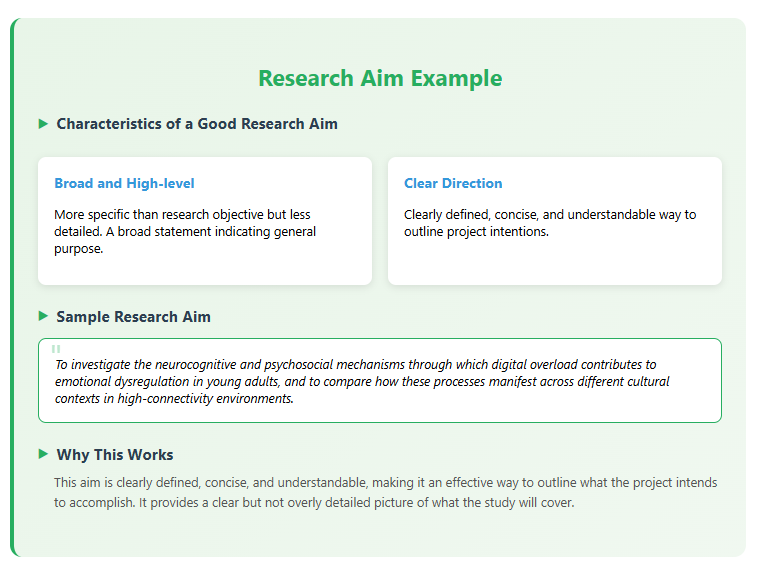
Example of Research Aim
- Broad and high-level
- An aim is always specific than your research objective but less detailed.
- It is a broad statement indicating the general purpose of the study.
- Sample aim
- “To investigate the neurocognitive and psychosocial mechanisms through which digital overload contributes to emotional dysregulation in young adults, and to compare how these processes manifest across different cultural contexts in high-connectivity environments.”
- This statement indicating the general purpose gives a clear but not overly detailed picture of what the study will cover.
- Explanation
- This aim is clearly defined, concise, and understandable, making it an effective way to outline what the project intends to accomplish.
Steps to Formulate Clear Research Objectives
- Step 1: Break down the aim
- After defining the aim, create objectives that are more specific than your research aim.
- These are well-defined steps that show how you will take to achieve the aim.
- Step 2: Objectives describe action
- Objectives describe measurable actions, usually written with active verbs such as analyse, evaluate, or compare.
- They should specify the focus, be concise, and remain understandable.
- Step 3: Order matters
- The first research objective should naturally follow from the aim.
- Each subsequent objective should add clear direction to the research process.
- Step 4: Avoid common mistakes
- Do not confuse objectives with the general purpose of your research; they are more specific research tasks.
- Do not make them too broad or unrelated to the methodology.
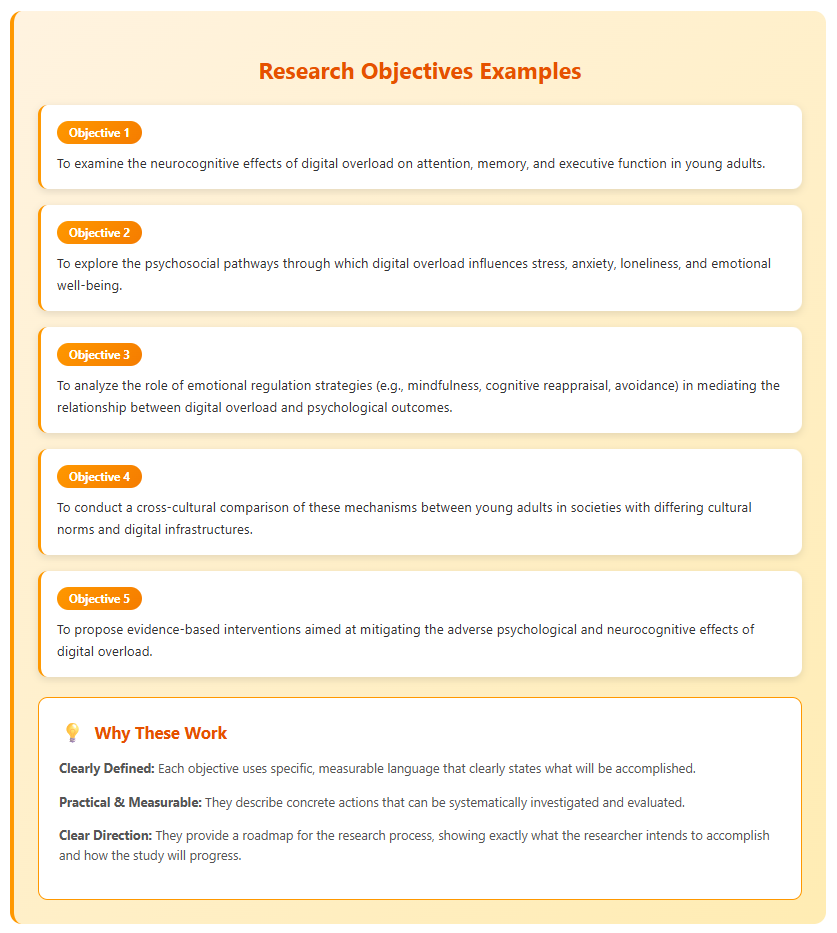
Examples of Research Objectives
- Objective 1: To examine the neurocognitive effects of digital overload on attention, memory, and executive function in young adults.
- Objective 2: To explore the psychosocial pathways through which digital overload influences stress, anxiety, loneliness, and emotional well-being.
- Objective 3: To analyze the role of emotional regulation strategies (e.g., mindfulness, cognitive reappraisal, avoidance) in mediating the relationship between digital overload and psychological outcomes.
- Objective 4: To conduct a cross-cultural comparison of these mechanisms between young adults in societies with differing cultural norms and digital infrastructures.
- Objective 5: To propose evidence-based interventions aimed at mitigating the adverse psychological and neurocognitive effects of digital overload.
- Explanation
- These specific research objectives are clearly defined, practical, and measurable.
- They show what the researcher intends to accomplish and provide clear direction for the research process.
Writing Research Objectives for Qualitative and Quantitative Studies
- Qualitative objectives
- Focus on exploration, explanation, and meaning.
- Example: “To explore how students describe their experiences of online learning environments.”
- These objectives are flexible but still clearly defined and concise.
- Quantitative objectives
- Focus on measurement, testing, and analysing variables.
- Example: “To test the relationship between study time online and exam performance.”
- These require a structured methodology with numerical data.
- Balance in academic writing
- Whether qualitative or quantitative, objectives should always be well-defined, relevant, and understandable.
- They provide the clear direction needed to avoid common mistakes during research.
Placement of Aims and Objectives in the Introduction Chapter
- Position in the introduction
- In a thesis or dissertation, the research aims and objectives are usually placed at the end of your problem statement within the introduction chapter.
- This ensures the reader knows the general purpose of your research early on.
- Link to research questions and methodology
- The overall aim informs the research questions and research objectives.
- The objectives then shape the methodology, guiding data collection, analysis, and interpretation.
- Clarity and relevance
- Placing aims and objectives here allows you to convey your study’s relevance and provide a clear direction for the reader.
- This positioning helps ensure that the research is both clearly defined and easy to follow.
- Academic impact
- Proper placement allows examiners or readers to see how your study intends to accomplish its goals.
- At the conclusion of your work, you revisit these aims and objectives to show what you were trying to achieve and whether you succeeded.