

Understanding Research Topics in Academic Writing
- A research topic is the central theme, issue, or phenomenon you intend to analyze in your research paper.
- Choosing the right research topic determines the effectiveness of your entire research process, as it sets the aim, scope, and methodology.
- In academic writing, clarity, precision, and relevance are essential. The topic must be specific enough to be researchable, but not too narrow that it lacks available literature or data.
- Using research topic and research question examples helps a researcher to formulate specific questions and a hypothesis that can guide your research.
What Makes a Good Research Topic?
- Feasible: The topic should be manageable within time, resources, and access to participants or data.
- Researchable: Must allow for collection of quantitative or qualitative evidence to answer a research question.
- Relevance: Should contribute to ongoing debate, theory, or practice in your field.
- Clear Variables: A good topic helps identify the variable, treatment, or intervention you want to test.
- Grounded in Methodology: Whether using quantitative research (with statistical analysis) or qualitative approaches (focused on subjective experiences), the topic must align with your chosen methodology.
- Preliminary Research: Conducting a background scan ensures sufficient sources exist to support your thesis.
- Examples:
- Quantitative: “The effectiveness of online ai learning tools in improving student performance.”
- Qualitative: “Exploring the subjective experiences of nurses in a pediatric cohort during the COVID-19 pandemic.”
Expert Dissertation Writing Services
Struggling with your dissertation? Elite Thesis Help provides top-tier research support, structured guidance, and professional writing services to ensure academic success. Get tailored assistance today and turn your research into excellence!
Examples of Research Topics Across Disciplines
- Education:
- The effectiveness of flipped classrooms as a teaching intervention.
- Comparative analysis of public vs. private school outcomes.
- Health Sciences:
- Exploring treatment adherence among diabetic patients.
- Quantitative research on the effectiveness of exercise programs in reducing hypertension.
- Social Sciences:
- Qualitative study of immigrant identity formation.
- Statistical study on unemployment trends in urban vs. rural areas.
- Technology:
- The role of ai in enhancing cybersecurity.
- Comparative evaluation of programming languages in machine learning.
- These examples of research show how research topic and research question examples can cross boundaries and still remain specific enough for investigation.
The Researcher’s Role in Grounding a Topic in Academic Writing
- Identify: A researcher must determine gaps in knowledge or pressing problems.
- Formulate: Convert a broad interest into a narrow and specific enough research topic.
- Develop Research Questions: Use research question examples to refine specific questions that can be tested.
- Guide Your Research: Well-designed examples of research questions ensure alignment between the topic, hypothesis, and methodology.
- Analyze: Apply either quantitative (using statistical tools) or qualitative approaches to assess the effectiveness of your intervention or to explore a subjective phenomenon.
- Debate & Relevance: A researcher contributes to scholarly debate by showing how findings influence practice, theory, or policy.
- Conduct: Ethical considerations are central—ensuring your study is feasible, respectful, and contributes meaningfully.
- Example of Research Questions:
- Quantitative: “Does ai-based tutoring improve math scores compared to traditional teaching?”
- Qualitative: “How do employees describe the effectiveness of hybrid work models?”
- Mixed Methods: “To what extent does hybrid work improve productivity, and how do employees perceive its relevance to their well-being?”
✅ Using research topic and research question examples provides a practical guide for every researcher to formulate, identify, and refine ideas that are researchable, feasible, and contribute to academic writing in a meaningful way.
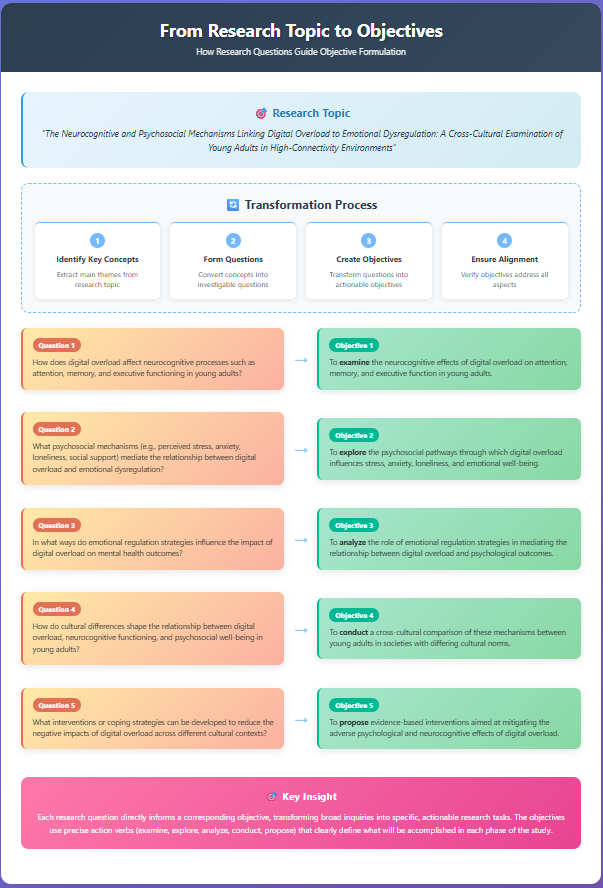
Developing Strong Research Questions
- A good research question is one of the most important foundations of any study because it determines the research design, approach, and relevance.
- A strong question is clearer, concise, and has a clear focus on a specific population or areas of study.
- Using research topic and research question examples helps a researcher test if the question must be answerable, arguable, and supported with empirical or theoretical evidence.
- A strong question provides direction to the inquiry and highlights possible solutions to the research problem while being practical within the timeline and time frame available.
Difference Between a Research Topic and a Research Question
- Research Topic: Broad areas of study or themes such as “The role of autism interventions in education” or “The efficacy of chemotherapy in cancer treatment.”
- Research Question: A well-defined inquiry that narrows the topic into specific enough issues that can be tested or explored.
- Example:
- Topic: “Neural responses to stress.”
- Question: “What are the indicator changes in neural activity when exposed to administrative workload stress?”
- Research topic and research question examples demonstrate how a question not only clarifies the focus but also makes it answerable through qualitative and quantitative methods.
Characteristics of a Good and Bad Research Question
- Good Research Question:
- Clearer and concise.
- Focused on certain variables with a target group or specific population.
- Has criterion for feasibility—timely, complex enough to encourage discussion, and arguable with counterarguments.
- Aligned with research design and supports prediction, causal analysis, or empirical testing.
- Bad Research Question:
- Question is too broad (e.g., “How does education affect society?”).
- Question is not focused enough (e.g., “What is health?”).
- Not answerable, lacks a clear focus, or cannot be supported with citation or data that is easily found.
- In short, a good research question helps resolve a dilemma within an academic field, whereas a poor one fails to guide effective inquiry.
Examples of Research Questions in a Thesis or Dissertation
- Predictive: “Can early autism interventions predict long-term academic success in children?”
- Causal: “What is the efficacy of combining chemotherapy and targeted therapy on survival rates in breast cancer patients?”
- Theoretical: “How does social identity theory explain workplace administrative dilemma in leadership?”
- Empirical: “Does meditation reduce stress in college students within a 6-month time frame?”
- These research topic and research question examples show how the question must be precise, well-defined, and fit the timeline of the project.
- When writing a thesis or dissertation, each question should target a specific population, address important parts of the research problem, and include room for counterpart views and counterarguments.
✅ Therefore, strong research topic and research question examples provide the indicator for quality research. They ensure that a researcher can design a study that is timely, arguable, and able to resolve complex academic challenges within their academic field.
Research Topic and Research Question Examples for Practice
- Using research topic and research question examples is one of the most important ways for students and researchers to strengthen their skills.
- A good research question provides clear focus, avoids being question is too broad or question is not focused enough, and targets a specific population within realistic time frame and timeline.
- The question must be answerable, arguable, and complex enough to allow discussion and counterarguments, yet concise and supported by citation from sources that can be easily found.
- A research problem becomes manageable once research topic and research question examples are used to demonstrate how to build well-defined inquiries across different areas of study.
Humanity and Social Science Research Question Examples
- Examples of Research in this academic field often explore human behavior, culture, or social issues.
- Qualitative and quantitative designs may both apply depending on the criterion:
- Qualitative inquiry can uncover possible solutions to a dilemma such as discrimination.
- Quantitative research provides empirical evidence using certain variables and indicator measures.
- Examples:
- “What are the experiences of parents of children with autism when navigating school systems?” (qualitative)
- “Does participation in community programs improve the efficacy of interventions for youth unemployment within a 12-month time frame?” (quantitative)
- “How does social identity theory offer a theoretical explanation for workplace administrative challenges?” (theoretical)
- Each question not only clarifies the research design but also shows how the researcher can resolve a pressing issue.
Examples of Research in Science and Technology
- In science and technology, predictive, causal, and empirical questions are common.
- A good research question in this academic field must include a clearer link between certain variables and the target outcome.
- Examples:
- “What is the efficacy of combining chemotherapy with immunotherapy in breast cancer patients?” (causal, medical)
- “What prediction can be made about neural responses to stress when workload increases?” (predictive, neuroscience)
- “Does artificial intelligence improve the administrative processes in hospitals within a 6-month timeline?” (empirical, AI)
- These research topic and research question examples highlight how question must remain practical, well-defined, and timely to impact both theory and practice.
How Research Topic and Research Question Examples Guide the Researcher
- Question must:
- Be answerable with a chosen research design.
- Fit within the time frame and available resources.
- Address important parts of the research problem while allowing for counterpart views and counterarguments.
- A good research question is not only about being concise—it should also be complex enough to encourage debate in the academic field.
- Examples:
- Causal: “How does daily exercise affect neural activity among a specific population of stroke survivors?”
- Predictive: “Can early intervention programs improve prediction of academic success for children with autism?”
- Theoretical: “What are the possible solutions to the dilemma of online privacy through existing ethical frameworks?”
- Using research topic and research question examples helps a researcher:
- Identify a feasible inquiry.
- Maintain a clearer structure for citation and data collection.
- Keep the study timely, arguable, and relevant to a specific population to be studied.
✅ In summary, research topic and research question examples serve as an essential indicator for any research problem. They ensure the question must remain well-defined, answerable, and arguable—enabling the researcher to resolve issues, test efficacy, and contribute meaningful knowledge across different areas of study.