

What Are the 5 Cs of a Literature Review?
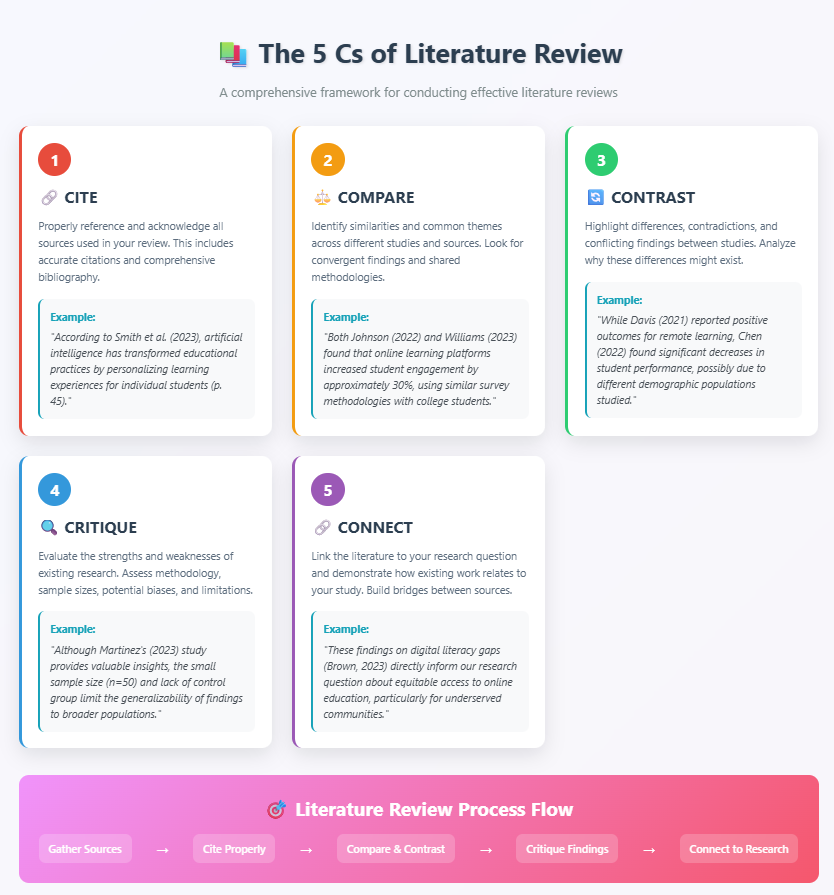
The 5 Cs of a literature review are central to producing clear, persuasive, and well-organised academic writing. They guide students and researchers in how to write a literature review that not only summarises existing literature but also critiques the literature, synthesises findings expressed in the literature, and links them to a specific research problem or research question. Each “C” represents a different skill that helps in writing good literature reviews across the social sciences and other fields of study.
Cite – Accurately Referencing Sources
- Definition:
- To “cite” is to draw upon existing literature and accurately record all sources in a bibliography.
- Referencing ensures that previous research is acknowledged and that your own research paper appears credible.
- Why It Matters:
- A review of literature that lacks accurate citation fails to situate the new area of research within the wider body of literature.
- Citations make it possible for readers to compare within the literature and check which studies seem most reliable.
- Practical Tip:
- Pay attention to the verbs you use to describe studies. For instance, use verbs like “argued”, “demonstrated”, or “reported” to show how findings were expressed in the literature.
- Example:
- In a thematic review of teaching strategies, Smith (2023) demonstrated how interactive methods improve student outcomes, while Brown (2022) argued that traditional lectures remain more persuasive for large classes.
Expert Literature Review Help
Get professional support from Elite Thesis Help for well-structured, critical, and plagiarism-free literature reviews. Strengthen your research with expert guidance tailored to your topic and academic needs.
Compare – Highlighting Similarities in Research
- Definition:
- To “compare” is to identify how different research studies or types of literature reviews align in their findings.
- Why It Matters:
- Comparing makes the area of research and investigation clearer and shows how your study fits into major areas already addressed in the existing literature.
- It helps readers to see the consensus in academic writing and understand what the findings expressed in the literature suggest collectively.
- Practical Tip:
- When you write your literature review, always compare within the literature using linking verbs such as “similarly noted”, “likewise observed”, or “agreed that”.
- Example:
- In the field of study of health policy, Green (2021) and Taylor (2020) both found that early interventions reduce hospital costs, showing similarity in outcomes across related research.
Contrast – Addressing Conflicting Viewpoints
- Definition:
- To “contrast” is to explore controversies expressed in the literature and highlight opposing various arguments.
- Why It Matters:
- Contrasting viewpoints are essential to expose controversy and gaps that remain unresolved in the body of literature.
- This process allows researchers to identify areas that require further area of research and investigation.
- Practical Tip:
- Use verbs carefully when showing contrasts. For instance, “challenged”, “contradicted”, or “disagreed” are verbs used to help highlight disputes.
- Example:
- In a review of leadership styles, Johnson (2022) concluded that transformational leadership enhances employee satisfaction, while Patel (2023) contradicted this by showing no significant effect, illustrating controversies expressed in the literature.
Critique – Evaluating Methods and Findings
- Definition:
- To critique the literature is to assess whether research methods and findings seem most reliable and valid.
- Why It Matters:
- Critiquing highlights weaknesses in research methods or flaws in methodology that may limit the strength of findings.
- Without critique, a review of literature merely becomes a summary rather than a piece of persuasive academic writing.
- Practical Tip:
- Pay attention to whether the methodology used aligns with the research problem. Comment on sampling, data collection, or analysis as appropriate.
- Example:
- While Williams (2020) provided persuasive arguments based on a large sample in the social sciences, the study relied solely on surveys. As a result, qualitative insights were absent, weakening the findings expressed in the literature.
Connect – Linking Research to Your Topic
- Definition:
- To “connect” is to show how previous research links directly to your research question, area of research, and the purpose of your own study.
- Why It Matters:
- Without explicit connection, the c’s of a literature review remain incomplete because readers cannot see how the existing literature relates to the new study.
- This step ensures that your literature review does not stand alone but supports your research paper and problem statement.
- Practical Tip:
- When you organise your literature review, explicitly state how findings expressed in the literature influence your own approach.
- Example:
- A review of environmental policies by Adams (2021) connects to the current study on climate education, showing how policy frameworks can inform educational interventions in the field of study.
How to Synthesize for a Good Literature Review
- Definition of Synthesis:
- To synthesise is to merge the 5 Cs of a literature review into one coherent whole.
- It is not enough to cite, compare, contrast, critique, and connect individually. A good literature review weaves these steps into one persuasive and thematic narrative.
- Why It Matters:
- Synthesis ensures that the review of literature demonstrates both breadth and depth in understanding the body of literature.
- It shows the reader how the literature review addresses major areas, builds on previous research, and reveals both agreements and controversies expressed in the literature.
- Strategies for Effective Synthesis:
- Organise your literature review thematically or chronologically depending on your area of research and investigation.
- Pay attention to the verbs you use to describe the studies; this helps differentiate between findings expressed in the literature, research methods, and author opinions.
- Always link back to your research problem and research question, ensuring that each source you draw upon supports your rationale for the study.
- Use synthesis to highlight which studies seem most reliable and which contain flaws in methodology.
- Ensure that your bibliography is accurate, reflecting all the sources cited in the body of the paper.
- Example of Synthesis:
- In the area of research on online learning, several studies converge on the effectiveness of blended learning (Lee, 2022; Carter, 2021). However, controversies expressed in the literature remain about student engagement levels (Nguyen, 2020), highlighting the need to critique the literature and connect findings to current practice.
The Literature Review Process and Its Importance
- Definition:
- Literature reviews are designed to provide a structured understanding of the topic by surveying sources you have explored.
- The 5 Cs of a literature review are often highlighted as a framework to demonstrate to your readers how your research fits within the body of existing work.
- Why Important:
- A literature review presents the work in the context of its contribution to the understanding of the subject.
- It allows you to evaluate the literature critically and explain the sources’ importance in relation to your research.
- The five ‘c’s of writing – cite, compare, contrast, critique, and connect – guide you in organising information in a way that demonstrates both depth and clarity.
- Example:
- When researching a particular topic, such as online learning, you might review the literature around a topic or issue like student engagement. Using the five ‘c’s helps highlight similarities you can compare and controversies that need further research.
Why Literature Reviews Matter in Research Papers
- Critical Part of Research:
- A literature review is a critical part of your literature because it shows readers how your research fits within what has already been said in the literature.
- The five ‘c’s of writing highlight how you cite existing sources, evaluate the literature, and connect findings to your own area.
- Contribution to Knowledge:
- Literature reviews are designed to provide contribution to the understanding of a particular topic.
- Explaining new or emerging research problems is possible only after you have reviewed the literature systematically.
- Example:
- Articles proved to be better than others – whether through methods or arguments that are more persuasive – can be identified and highlighted as part of your literature review.
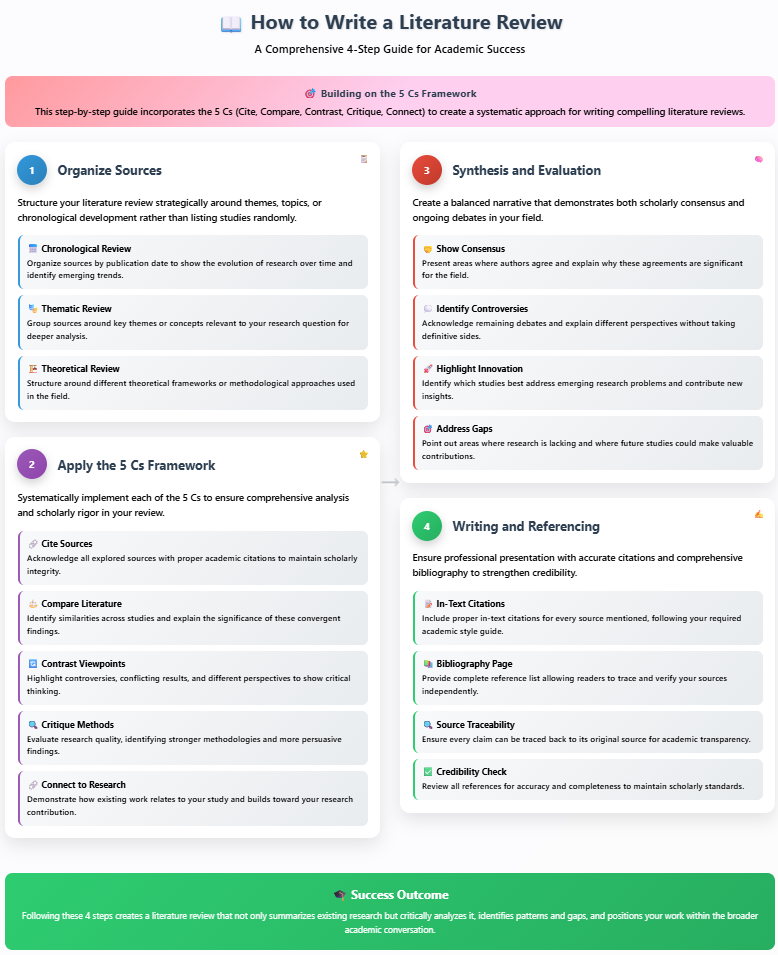
How to Write a Literature Review Step by Step | 4 Step Guide
- Step 1 – Organise Sources:
- Organise your literature review surveys around a topic or issue rather than listing studies randomly.
- Pay attention to whether the literature is a chronological review, a thematic review, or a theoretical literature review.
- Step 2 – Apply the 5 Cs of a Literature Review:
- Cite the literature to acknowledge the sources you have explored.
- Compare within the literature to explain how they are similar and the importance of these similarities.
- Contrast viewpoints to highlight controversies and arguments.
- Critique the literature to show which research methods are stronger and which findings are more persuasive.
- Connect the literature to your own area of research, showing how your work builds on previous studies.
- Step 3 – Synthesis and Evaluation:
- Demonstrate to your readers how the literature review presents a balanced picture of what authors agree on and where controversies remain.
- Mention which articles proved to be better in addressing new or emerging research problems.
- Step 4 – Writing and Referencing:
- Ensure that citations must be in-text and supported by a separate bibliography page.
- This helps readers trace the sources and strengthens the credibility of your review.
Types of Literature Reviews in Social Sciences
- Chronological Review:
- Explains how research on a particular topic has developed over time.
- Useful when explaining new or emerging research problems and situating them historically.
- Thematic Review:
- Organised around a topic, theme, or issue rather than by time.
- Effective when there are many aspects to compare within the literature.
- Theoretical Literature Review:
- Evaluates the literature to your own area by considering theories, models, and frameworks.
- Demonstrates how different approaches contribute to the understanding of the topic.
- Practical Point:
- A good literature review presents examples of aspects where similar approaches were applied, allowing you to explain how they are similar or why some arguments are more persuasive than others.
Building a Bibliography for Your Review of Literature
- Purpose of a Bibliography:
- The bibliography is a critical part of your literature review because it records all sources reviewed.
- It supports academic writing by showing the depth of the research paper.
- How to Build One:
- Use a consistent referencing style and ensure all citations must be in-text and listed on a separate bibliography page.
- Mention which articles proved to be better supported by evidence and how their arguments fit into the body of literature.
- Connection to the 5 Cs of a Literature Review:
- By citing properly, critiquing the methods, comparing and contrasting findings, and connecting the literature to your own area of research, the bibliography becomes a record of the sources that underpin your analysis.
- Example:
- In the social sciences, when conducting a theoretical literature review on leadership, sources like Smith (2022) and Patel (2021) might be cited to explain the sources’ importance in shaping your understanding of the topic.
Frequently Asked Questions About 5 Cs of a Literature Review
What are the 5 Cs of a literature review?
The 5 Cs of a literature review are:
- Cite – Accurately reference the sources you have reviewed.
- Compare – Highlight similarities between studies and explain the importance of these similarities.
- Contrast – Address conflicting viewpoints and controversies expressed in the literature.
- Critique – Evaluate the strengths and weaknesses of methods, findings, and arguments.
- Connect – Link the reviewed literature to your own research question or area of investigation.
These five ‘c’s of writing help you demonstrate to your readers how your research fits into the broader body of literature.
What are 5 parts of a literature review?
A well-structured literature review usually contains five main parts:
- Introduction – Explains the purpose of the review and the research problem being addressed.
- Survey of Literature – Reviews the sources you have explored and describes how they relate to the particular topic.
- Organisation – Presents the literature in a logical way, e.g., chronological review, thematic review, or theoretical literature review.
- Discussion and Critique – Evaluates the literature, explains the sources’ importance, and highlights controversies expressed in the literature.
- Conclusion – Summarises the main findings and shows readers how your research fits into the context of its contribution.
What are the 5 C’s of academic writing?
The 5 C’s of academic writing are widely recognised principles for producing clear, persuasive, and professional work:
- Clarity – Write in a way that is easy to follow and avoids unnecessary complexity.
- Conciseness – Present information directly without wordiness or redundancy.
- Consistency – Maintain uniformity in terminology, style, and referencing.
- Correctness – Use accurate grammar, spelling, and citation rules.
- Credibility – Support your arguments with evidence from reliable and well-cited sources.
These five ‘c’s ensure that your academic writing is effective, professional, and persuasive.
What are the 5 characteristics of a good literature review?
A good literature review is judged by five key characteristics:
- Comprehensive – Covers all major areas of research and includes relevant sources.
- Critical – Goes beyond description to evaluate the literature and point out which arguments are more persuasive.
- Organised – Structured around a topic, theme, or issue, allowing readers to follow easily.
- Contextualised – Places the literature you are reviewing within the context of its contribution to understanding of the subject.
- Connected – Demonstrates how the review supports your research paper and describes how your work adds to the understanding of the topic.
Together, these characteristics show that the literature review is a critical part of academic writing and contributes to explaining new or emerging research problems.