

Introduction
- A literature review is a cornerstone of academic research and professional inquiry, providing an organised way of analysing and synthesising available research. It helps clarify what is already known, where the gaps in the literature lie, and how future research can be shaped.
- Because there are many types of literature review, choosing the most appropriate review type depends on the research problem, the scope of the research, and the intended methodology.
- Some researchers may need a descriptive overview of a broad topic, while others may prefer the rigour of a systematic literature review or a meta-analysis that synthesises data from multiple studies.
- Understanding the different types of literature review is not only a matter of academic compliance but also a strategic step in shaping a strong research agenda.
- Each type of review—from narrative literature review to umbrella review—plays a specific role in mapping research activities, identifying research gaps, and supporting evidence-based decision-making.
- This article outlines the major types of literature review and explains how the literature review process can be managed effectively to support a well-defined research topic.
How to Write a Literature Review | Understanding the Literature Review Process in 4 Steps
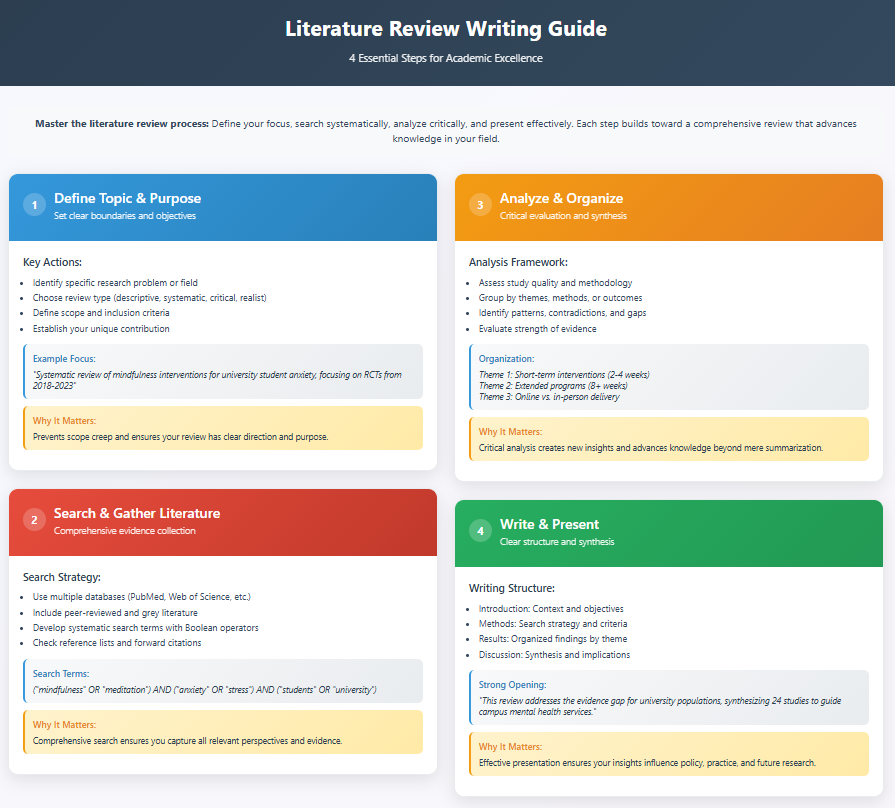
A literature review may vary in length, depth, and structure depending on the academic discipline, but the steps remain consistent. The process requires careful planning, evaluation of primary research, and alignment with guidelines for conducting literature reviews. Below are four essential steps.
Need Literature Review Help?
Get expert assistance from Elite Thesis Help to craft clear, well-structured, and high-quality literature reviews. Save time, address research gaps, and strengthen your thesis today!
Step 1: Define the Research Topic and Purpose
- Clarify the research topic:
- Identify the need for the review.
- Specify whether the focus is on research on a specific problem, a broad field, or a particular aspect of available research.
- Determine the review type:
- Choose among the four major types of approaches—descriptive reviews, systematic literature reviews, critical reviews, or realist review—depending on scope and objectives.
- This choice ensures the literature review is conducted with the right focus.
- Why this matters:
- Defining the research topic prevents scope creep.
- Provides clarity on how literature reviews play a role in shaping the research agenda.
Step 2: Search and Gather Relevant Literature
- Plan the search strategy:
- Use academic databases, journals, and different types of review articles.
- Include primary research and review articles to create a comprehensive evidence base.
- Scope of sources:
- Cover published literature, grey literature, and other available research.
- Acknowledge the nature of research activities in the field, such as whether the discipline favours experimental, observational, or theoretical studies.
- Why this matters:
- A robust search ensures that the literature review may capture all relevant perspectives.
- Supports evidence-based conclusions when comparing different types of literature review.
Step 3: Analyse, Evaluate, and Organise Findings
- Critically examine sources:
- Look at strengths, limitations, and contributions of primary research.
- Decide whether studies align with the review article provides guidance for answering your research topic.
- Organise by theme or methodology:
- Group studies by recurring themes, nature of research activities, or theoretical contributions.
- For example, descriptive reviews may summarise findings, while a realist review seeks to explain underlying mechanisms.
- Why this matters:
- Ensures that literature reviews play a critical role in advancing knowledge rather than merely summarising.
- Encourages deeper engagement with available research.
Step 4: Write and Present the Review
- Structure the text:
- Clearly show how the literature review is conducted, from search to synthesis.
- Follow guidelines for conducting literature reviews in your discipline.
- Balance description and critique:
- Use descriptive reviews for summary.
- Apply evaluative commentary to show strengths, limitations, and gaps in the research.
- Why this matters:
- A well-written review signals the need for the review in addressing a research problem.
- It highlights how a review article provides evidence for policy, practice, or future research directions.
Major Types of Literature Review
When conducting academic research, one must understand the types of literature review available, as each review type serves a different purpose, methodology, and scope. A literature review is not a single format but a spectrum of approaches that vary in research methods, analysis depth, and the nature of research evidence they synthesise. Below are the most widely recognised different types of literature review, each explained with its unique strengths and applications.
Narrative Literature Review
- Definition:
A narrative literature review (also referred to as a narrative review) provides a descriptive summary of the existing literature on a broad topic. - Methodology:
- Does not follow a strict systematic review process.
- Uses descriptive techniques to synthesise the literature.
- Can include both historical reviews and theoretical reviews.
- Key Characteristics:
- Flexible review methodology.
- Useful when the aim is to explore a large body of research.
- Allows analysis of relevant literature without the rigid reporting structure of a systematic literature review.
- Applications:
- Common in academic research and coursework when students are asked to write a literature review.
- Effective for outlining research activities in a particular area.
Systematic Literature Review
- Definition:
A systematic literature review is a rigorous, transparent, and replicable review type that uses a structured systematic review method to answer a specific research question. - Methodology:
- Requires predefined inclusion and exclusion criteria.
- Uses a comprehensive literature search, often including grey literature.
- Ensures reproducibility and minimises bias.
- Key Characteristics:
- Often reported according to statement for reporting systematic reviews and meta-analyses guidelines.
- Involves clear documentation of the review process.
- Can include both qualitative systematic review and full systematic review approaches.
- Applications:
- Preferred in health sciences, social sciences, and education.
- Used to inform policy, identify research gaps, and guide a research agenda for future studies.
Critical Literature Review
- Definition:
A critical review goes beyond mere description of published literature; it involves critical evaluation of the strengths and weaknesses of the research evidence. - Methodology:
- Evaluates methodological quality and validity of studies.
- Requires a deeper analysis of the literature.
- Key Characteristics:
- Engages with gaps in the research and research problem framing.
- Aims to influence a research agenda by identifying flawed research activities.
- Applications:
- Suitable for academic research at postgraduate level.
- Provides foundation for future research by emphasising research is needed in certain domains.
Integrative Review
- Definition:
An integrative review synthesises both qualitative research and quantitative studies. - Methodology:
- Combines data from multiple studies using different types of research.
- Aims to create a comprehensive understanding of a research area.
- Key Characteristics:
- Flexible review process that accommodates diverse research literature.
- Highlights gaps in the literature and creates a research agenda for future work.
- Applications:
- Popular in nursing, psychology, and social sciences.
- Useful when exploring multiple studies across methodologies.
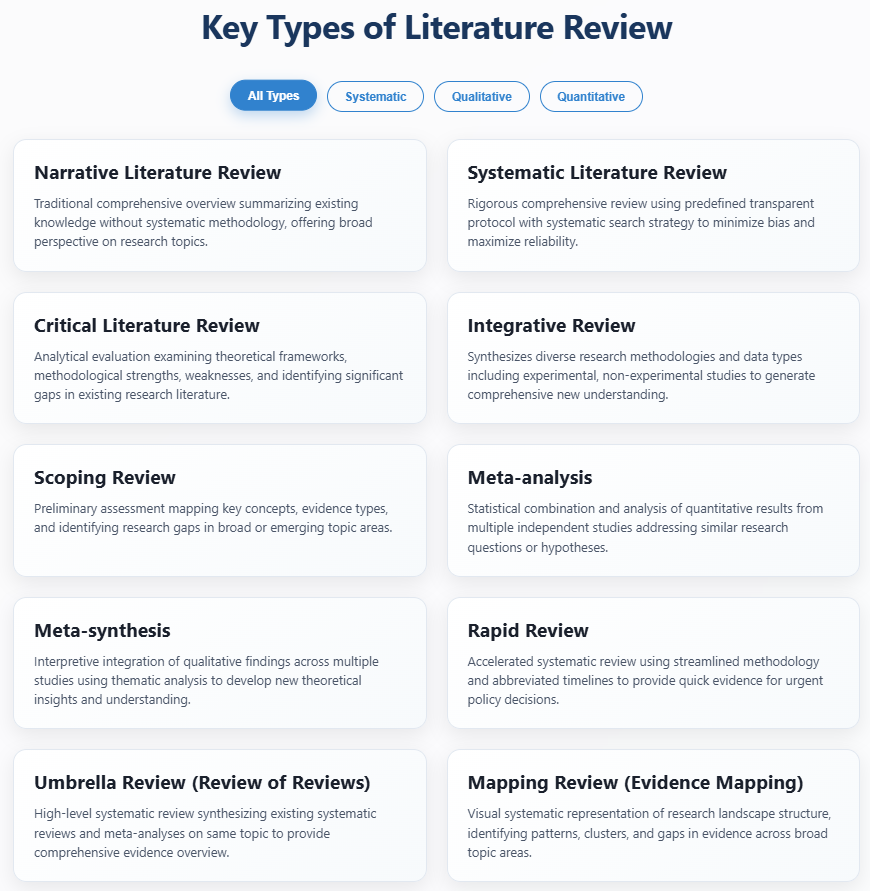
Scoping Review
- Definition:
A scoping review maps the scope of the research in a field. - Methodology:
- Less restrictive than a systematic review.
- Identifies the breadth of literature on a particular topic.
- Key Characteristics:
- Useful when research question is broad.
- Reviews can also include grey literature and reviews published.
- Applications:
- Helps researchers determine whether a full systematic review is warranted.
- Identifies gaps in the research and informs future research activities.
Meta-analysis
- Definition:
A meta-analysis is a statistical technique used within a systematic review to combine findings from multiple systematic reviews or primary studies. - Methodology:
- Pools quantitative research findings from different studies.
- Provides stronger research evidence by increasing statistical power.
- Key Characteristics:
- Relies on rigorous systematic review process.
- Considered a high-level review type in the typology of reviews.
- Applications:
- Common in medicine, psychology, and education.
- Supports evidence-based decision-making.
Meta-synthesis
- Definition:
A meta-synthesis integrates qualitative research studies to generate new interpretations. - Methodology:
- Involves interpretive techniques rather than statistical pooling.
- Synthesises themes from narrative literature and qualitative research methods.
- Key Characteristics:
- Provides a deeper understanding of complex human experiences.
- Builds theoretical models from qualitative systematic review.
- Applications:
- Widely used in nursing, education, and social sciences.
- Supports the development of new frameworks for research activities.
Rapid Review
- Definition:
A rapid review accelerates the systematic review process to deliver timely findings. - Methodology:
- Simplifies certain steps such as literature search and screening.
- May use fewer reviewers or limit literature on a topic.
- Key Characteristics:
- Balances speed with rigour.
- May sacrifice comprehensiveness for practicality.
- Applications:
- Useful in urgent decision-making, such as public health emergencies.
- Provides policymakers with relevant insights quickly.
Umbrella Review (Review of Reviews)
- Definition:
An umbrella review, also called a review of reviews, summarises findings from multiple systematic reviews and meta-analyses of studies. - Methodology:
- Synthesises results across different types of literature review.
- Requires evaluation of review papers rather than primary studies.
- Key Characteristics:
- Provides high-level research evidence.
- Useful for identifying consistencies and contradictions across review types and associated methodologies.
- Applications:
- Widely used in health sciences and social sciences.
- Supports policy by drawing from findings from multiple systematic reviews.
Mapping Review (Evidence Mapping)
- Definition:
A mapping review (also known as evidence mapping) systematically identifies and categorises literature on a topic. - Methodology:
- Uses a descriptive approach to chart research activities in a particular field.
- Often displayed in visual form for clarity.
- Key Characteristics:
- Highlights gaps in the literature and areas where research is needed.
- Provides a review article that functions as a research map.
- Applications:
- Effective for developing a research agenda for future projects.
- Common in health sciences and policy analysis.
Key Takeaways
- The types of literature review range from descriptive approaches such as the narrative literature review to highly structured methods like the systematic literature review and meta-analysis.
- Each specific type of review serves a unique role in academic research: identifying research gaps, guiding a research agenda, or synthesising data from multiple studies.
- Understanding the different types of literature review is essential for selecting the most appropriate review methodology when addressing a specific research question or research problem.
- Whether one conducts a scoping review to explore the literature on a broad topic, a critical review to evaluate existing literature, or an umbrella review to summarise reviews and meta-analyses of studies, the choice of review type shapes the literature review process and ultimately influences the research findings.